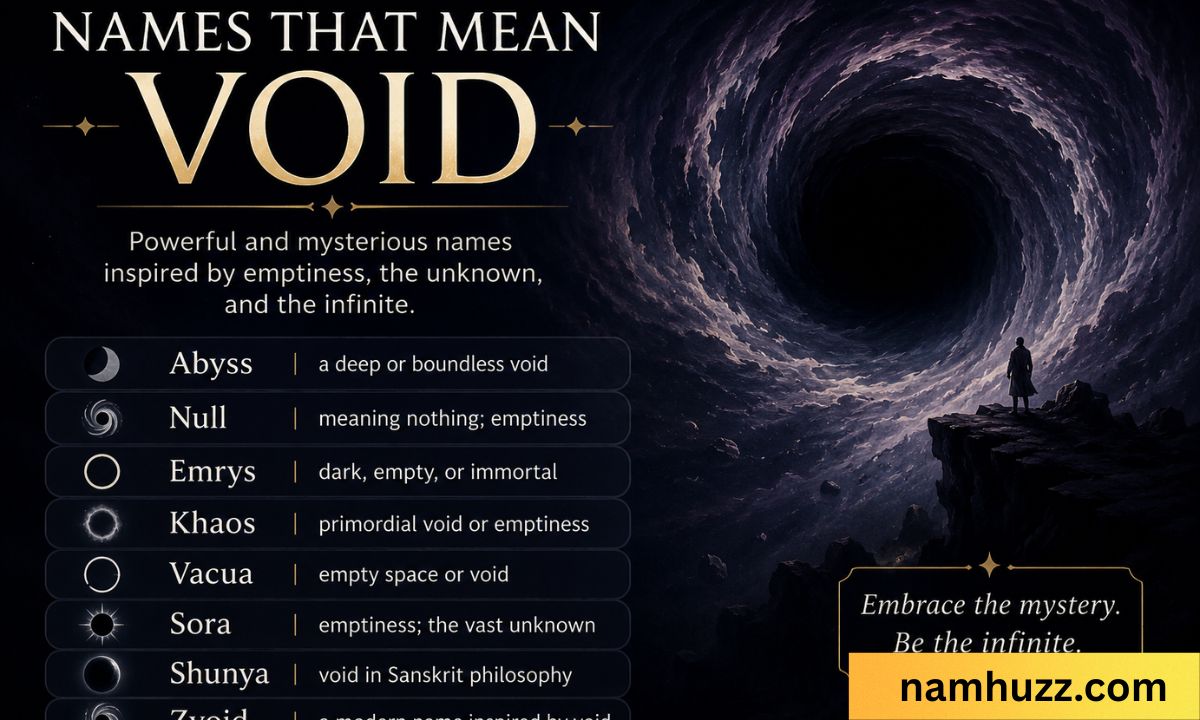
Some names carry the weight of empty space. They speak of nothingness, silence, and the unknown. These names feel deep and mysterious.
Parents often search for names that stand out. A name meaning “void” feels bold and different. It shows strength in darkness and quiet power.
This list brings together unique void-inspired names. Each one carries a special meaning and story. They are perfect for those who love mystery and depth.
What Are the Best Names That Mean Void?
- Chaos : The Greek primordial void that existed before creation itself. A bold, mythic choice for parents drawn to origin stories.
- Nyx : Greek goddess of night, born of Chaos and cloaked in cosmic darkness. Soft-sounding yet deeply symbolic.
- Shunya : Sanskrit for “zero” or “void,” rooted in ancient Indian philosophy and mathematics. Carries both spiritual and intellectual weight.
- Tohu : Hebrew word for the “formless void” described in Genesis. Ancient, biblical, and strikingly minimal.
- Erebus : Greek god of deep darkness and shadow, sibling to Chaos. Evokes mystery without feeling harsh.
- Kuu : Japanese for “empty” or “sky,” light and open rather than heavy. A gentle nod to vastness.
- Nihil : Latin for “nothing,” the philosophical root of nihilism. Stark, minimalist, and unmistakably direct.
- Wu : Chinese term central to Daoist thought, meaning nothingness or non-being. Short, calm, and contemplative.
- Ain : Hebrew kabbalistic term for “nothingness,” the state before divine emanation. Quiet and mystical in tone.
- Xu : Chinese for emptiness or void, used in classical philosophy. Simple in sound but rich in meaning.
- Sunyata : The fuller Sanskrit/Buddhist term for emptiness as a spiritual concept. Melodic and layered with depth.
- Void (used directly) : A modern, unconventional choice taken straight from the English word itself. Striking and unmistakably literal.
- Abyss (used directly) : Evokes a bottomless void or chasm, dramatic and intense. Popular in fantasy-inspired naming.
- Kali : While primarily meaning “black” or “time,” Kali is linked in some traditions to the void that precedes destruction and rebirth. Powerful and fierce.
- Nothos : Greek-rooted term suggesting absence or illegitimacy of form. Rare and unusual, favored by inventive namers.
- Empt (short form of “empty,” modern coinage) : A stripped-down, invented name emphasizing bareness. Unconventional and minimalist.
Boy Names That Mean Void or Emptiness
- Erebus : Greek god of shadow and darkness, born from primordial Chaos. Strong and mythologically grounded.
- Chaos : The empty gulf before the ordered universe existed. A dramatic, ancient choice for a boy.
- Tohu : Hebrew for the formless emptiness before creation. Short, weighty, and rarely used.
- Wu : Chinese Daoist term for nothingness or non-being. Calm and philosophical in tone.
- Nihil : Latin word for “nothing,” associated with the philosophy of nihilism. Blunt and intellectually striking.
- Xu : Chinese for void or emptiness, tied to classical Daoist texts. Brief and quietly powerful.
- Kuu : Japanese meaning “empty” or “sky,” airy rather than dark. A softer take on the void theme.
- Anshu (reinterpreted) : In some usages linked to vast, empty light; a rare crossover name. Gentle and unusual.
- Vakhtan (stylized) : An invented modern name evoking vastness and absence. Distinctive and easy to pronounce.
- Nulla : Latin for “none” or “nothing,” used in legal and philosophical Latin phrases. Sharp and minimalist.
- Kenos : From the Greek “kenosis,” meaning emptying or self-emptying. Theologically rich and rarely heard.
- Bardo : Tibetan Buddhist term for the empty transitional state between lives. Mystical and evocative.
- Rikutsu (stylized Japanese) : Suggests hollow logic or empty reasoning in some readings. Unusual and thought-provoking.
- Havoc : Not etymologically “void,” but often chosen for its sense of emptied-out destruction. Bold and modern.
- Ozar (invented) : A modern coinage meant to sound vast and echoing, like an empty canyon. Distinctive sound.
- Draven (stylized) : A modern name often associated in pop culture with darkness and hollow sorrow. Popular with fantasy fans.
- Nolan (reinterpreted) : While traditionally Irish for “champion,” some modern lists link it loosely to “noble emptiness.” Familiar and easy to wear.
- Corvin (stylized) : Evokes raven-like darkness and shadowed absence. Gothic and striking.
- Kael (stylized) : A modern invented name often used in fiction to suggest hollow strength. Sleek and contemporary.
- Zephyr (reinterpreted) : Traditionally the west wind, sometimes used to suggest an empty, open expanse. Airy and light.
Girl Names That Mean Void With Deep Meanings
- Nyx : Greek goddess of night and darkness, daughter of Chaos itself. Mysterious yet melodic for a girl.
- Sunyata : Sanskrit/Buddhist term for emptiness as spiritual liberation. Flowing and meaningful.
- Ain : Hebrew kabbalistic word for divine nothingness before creation. Short, soft, and profound.
- Kali : Associated with time, destruction, and the void that precedes renewal. Fierce and commanding.
- Erebos (feminine styling) : A softened take on the Greek god of darkness. Unusual but evocative.
- Tohuah (stylized from Tohu) : A feminized version of the Hebrew word for formless void. Rare and biblical.
- Kuuko : Japanese-inspired, building on “kuu” (empty/sky) with a feminine ending. Gentle and airy.
- Vasha (invented) : Meant to evoke vastness and open emptiness. Soft-sounding and modern.
- Nihila (feminized Nihil) : A stylized feminine form of the Latin word for nothing. Bold and unconventional.
- Xena (reinterpreted) : Though traditionally meaning “hospitable,” some modern namers link it loosely to open, empty strength. Familiar and strong.
- Elowen (reinterpreted) : Cornish for “elm,” sometimes chosen for its airy, open feel evocative of empty forests. Soft and nature-linked.
- Ombra : Italian for “shadow,” suggesting the darkness of an empty space. Elegant and lyrical.
- Vera Nihil (compound, invented) : A modern pairing meant to suggest “true nothingness.” Poetic and unusual.
- Selas (invented) : A modern coinage meant to sound like quiet, glowing emptiness. Soft and gentle.
- Marren (reinterpreted) : Loosely tied in modern naming circles to “empty sea” imagery. Watery and evocative.
- Isolde (reinterpreted) : Traditionally “ice ruler,” sometimes chosen for its association with cold, empty landscapes. Romantic and literary.
Names That Mean Empty Vessel
- Kelila (reinterpreted) : In some traditions loosely tied to an open, receptive vessel. Soft and lyrical.
- Baotu (stylized) : Suggests an empty container awaiting purpose, inspired by East Asian pottery imagery. Distinctive and rare.
- Amphora : Named directly after the ancient empty ceramic vessel used for storage. Classical and elegant.
- Urn (used directly) : A stark name taken from the vessel itself, symbolizing empty containment. Minimal and bold.
- Kalasha : Sanskrit for a ceremonial pot, often empty until filled with sacred water. Spiritual and evocative.
- Vessela (Slavic-inspired) : Loosely connected to “vessel” through sound and symbolism. Musical and graceful.
- Chalice (used directly) : An empty ceremonial cup awaiting purpose, rich with symbolic weight. Elegant and reverent.
- Cauldron (stylized, rare) : Suggests an empty pot before it is filled with transformation. Bold and unconventional.
- Anfora (Italian for amphora) : A softened European variant of the classical vessel name. Lyrical and refined.
- Hollis (reinterpreted) : Traditionally tied to “holly,” but phonetically echoes “hollow” or empty space. Familiar yet symbolic.
- Tureen (rare, stylized) : Named after the empty serving vessel, chosen for its unusual sound. Distinctive and unconventional.
- Basina (invented) : Suggests a shallow, open, empty basin. Soft and gentle.
- Jarrah (reinterpreted) : Primarily an Australian eucalyptus tree name, sometimes linked to “jar” imagery of emptiness. Earthy and grounded.
- Krater : Named after the ancient Greek vessel used for mixing, often empty before use. Classical and strong.
Names That Mean Nothingness
- Nihil : Latin for “nothing,” the direct root of nihilism. Blunt and philosophically loaded.
- Wu : Chinese Daoist concept of nothingness or non-being. Calm, brief, and contemplative.
- Ain : Hebrew mystical term for nothingness preceding creation. Quiet and profound.
- Sunyata : Buddhist term describing emptiness as a state of liberation from attachment. Flowing and spiritually rich.
- Mu : Japanese Zen term for “nothing” or “non-being,” often used in koans. Short and deeply philosophical.
- Nulla : Latin for “none,” used in legal and logical contexts. Sharp and minimalist.
- Rien : French for “nothing,” soft in sound but stark in meaning. Elegant and understated.
- Niente : Italian for “nothing,” often used musically to mean fading to silence. Lyrical and evocative.
- Nada : Spanish for “nothing,” simple and widely recognizable. Warm-sounding despite its stark meaning.
- Ingenting (Scandinavian-inspired) : Loosely evokes “nothing” in Nordic languages. Rare and unusual.
- Nix : Latin-derived slang for “nothing,” short and punchy. Modern and easy to use.
- Anatta : Buddhist term for “non-self,” related to the absence of fixed identity. Philosophical and rare.
- Ceto (reinterpreted) : Loosely connected in modern naming lore to vast oceanic emptiness. Mythic and oceanic.
- Nullus : Latin adjective form of “none,” rarely used but striking. Bold and unconventional.
Unisex Names That Symbolize the Void
- Nyx : Greek personification of night, fittingly androgynous in modern usage. Dark, elegant, and widely embraced for any gender.
- Chaos : The primordial void itself, used increasingly as a unisex name. Bold and dramatic for any child.
- Wu : Chinese term for nothingness, naturally gender-neutral in sound and use. Calm and philosophical.
- Kuu : Japanese for “empty” or “sky,” soft and balanced across genders. Airy and gentle.
- Sol Void (compound, invented) : A modern pairing suggesting sunlit emptiness. Unusual and poetic.
- Ash (reinterpreted) : Traditionally tied to the ash tree, but its bareness after fire evokes emptiness. Familiar and versatile.
- Sable : Meaning “black,” often used to suggest the darkness of void-like space. Sleek and modern.
- Onyx : A black gemstone name evoking deep, void-like darkness. Popular and striking for any gender.
- Raze (invented, stylized) : Suggests the empty space left after destruction. Edgy and modern.
- Void (used directly) : A literal, gender-neutral choice taken from the English word. Minimal and unmistakable.
- Kenos : Greek-rooted term for emptying or self-emptying, naturally neutral in tone. Rare and thoughtful.
- Umbra : Latin for “shadow,” evoking the darkness of empty space. Elegant and balanced across genders.
- Zero (used directly) : A numeric name symbolizing nothingness and the void. Modern, bold, and easy to say.
- Null (used directly) : Taken from mathematics and computing, meaning empty or absent value. Sleek and contemporary.
- Blank (used directly) : A stark, literal name suggesting an empty page or space. Minimalist and unconventional.
- Hollow (used directly) : Directly evokes emptiness, often softened in tone despite its meaning. Distinctive and rare.
Names That Mean Void (Girl-Focused)
- Nyxandra (invented, feminine) : A stylized elaboration of Nyx, goddess of night and void. Elegant and dramatic.
- Voidessa (invented) : A fully modern coinage feminizing “void” with a lyrical ending. Unique and bold.
- Kalindi (reinterpreted) : Loosely tied in some modern naming lists to flowing emptiness. Musical and graceful.
- Sable Rose (compound, invented) : Pairs dark emptiness with softness, popular in modern naming trends. Romantic and layered.
- Umbriel : A moon of Uranus named for shadow, evoking a dark, empty celestial body. Cosmic and mysterious.
- Nocturne : French/Italian-rooted word evoking night’s quiet emptiness. Musical and atmospheric.
- Selene Void (compound, invented) : Pairs the moon goddess with emptiness for a celestial feel. Poetic and rare.
- Ombrelle (stylized from “ombra”) : A softened feminine variant meaning shadow or emptiness. Lyrical and refined.
- Absentia : Latin-rooted, directly evoking absence and emptiness. Dramatic and literary.
- Vashti Void (compound, invented) : Combines a biblical name with modern void imagery. Unusual and bold.
- Erelah (invented, feminine) : A softened variant echoing Erebus, the god of darkness. Mysterious and rare.
- Cavum (Latin for “hollow” or “cavity,” feminized) : Suggests an empty hollowed space. Rare and distinctive.
Names in Different Languages That Mean Void (Star-Themed)
- Kenshin (stylized, Japanese-inspired) : Loosely evokes an empty or humble heart beneath the stars. Reflective and rare.
- Shunyatara (Sanskrit compound) : Combines “shunya” (void) with “tara” (star), meaning “void star.” Deeply poetic and spiritual.
- Nyxstar (compound, invented) : Pairs the Greek night goddess with “star” for a cosmic void theme. Modern and dramatic.
- Ain Kochav (Hebrew compound) : Loosely translates to “no star” or “star of nothingness.” Rare and mystical.
- Kuu Hoshi (Japanese compound) : “Kuu” (empty) plus “hoshi” (star), meaning “empty star.” Lyrical and gentle.
- Wu Xing Void (Chinese-inspired, stylized) : Evokes the emptiness beyond the five elements and stars. Philosophical and rare.
- Tohu Kochav (Hebrew compound) : Combines “formless void” with “star.” Ancient and poetic.
- Nihil Astra (Latin compound) : Combines “nothing” with “astra” (stars), meaning “star of nothingness.” Dramatic and literary.
- Sterren Leeg (Dutch-inspired compound) : Loosely translates to “empty stars.” Rare and evocative.
- Etoile Vide (French compound) : Directly translates to “empty star.” Elegant and poetic.
- Estrella Vacía (Spanish compound) : Means “empty star,” romantic yet melancholic. Lyrical and warm-sounding.
- Stella Nihili (Latin-Italian hybrid) : Combines “star” with “of nothing.” Dramatic and classical.
- Boshi Kuu (stylized Japanese) : Suggests a “hat” or “cap” of emptiness beneath the stars in poetic reinterpretation. Rare and unusual.
- Zvezda Praznina (Slavic compound) : Translates loosely to “star of emptiness” in Slavic languages. Bold and distinctive.
Names Meaning Void or Abyss
- Abyssos : The original Greek word for “bottomless,” root of the English “abyss.” Deep, dramatic, and mythic.
- Erebus : God of primordial darkness, closely tied to the abyss in Greek cosmology. Strong and ancient.
- Tartarus : The Greek deep abyss beneath the underworld, reserved for the darkest depths. Intense and mythological.
- Kali Ma : Associated with the destructive void that precedes cosmic renewal. Fierce and powerful.
- Naraka : Sanskrit/Buddhist term for the deep hellish abyss. Weighty and spiritually significant.
- Chasm (used directly) : A literal English word for a deep void or gap. Bold and unconventional as a name.
- Gouffre : French for “abyss” or “chasm,” poetic and evocative. Elegant with a dramatic meaning.
- Abgrund : German for “abyss,” literally “without ground.” Strong, guttural, and striking.
- Uchi no Fuchi (stylized Japanese) : Loosely evokes an inner abyss or deep pit. Rare and poetic.
- Voragine : Italian for “chasm” or “whirlpool of the abyss.” Dramatic and lyrical.
- Barathron : Ancient Greek term for a deep pit or abyss used in mythic punishment. Rare and intense.
- Fossa : Latin for “ditch” or “deep pit,” used scientifically for oceanic trenches. Sleek and modern-sounding.
- Profundus : Latin for “deep,” root of “profound,” evoking the depth of the abyss. Elegant and weighty.
- Sheol : Hebrew term for the shadowy underworld abyss. Ancient, biblical, and solemn.
- Duat : Ancient Egyptian term for the dark underworld realm, a mythic void. Mysterious and historic.
- Kur : Sumerian term for the underworld abyss, one of humanity’s oldest void concepts. Ancient and rare.
- Malebolge : Dante’s chasm of the abyss in the Inferno, layered and symbolic. Literary and dramatic.
- Yawning Gulf (descriptive, stylized as “Yawn”) : A poetic English phrase shortened into a rare, evocative name. Unusual and bold.
- Xibalba : Mayan term for the dark underworld, a place of void and shadow. Mythic and distinctive.
- Annwn : Welsh term for the otherworld, an ethereal void beyond the living. Lyrical and steeped in folklore.
Japanese Names That Mean Void or Nothingness
- Kuu : Means “empty” or “sky,” rooted in the Buddhist concept of shunyata.
- Mu : A single-syllable word meaning “nothing” or “non-existence” in Zen teaching.
- Rei : Written with the kanji for “zero,” symbolizing a state of nothingness.
- Kyomu : Translates as “nihility,” used in classical Japanese philosophy texts.
- Kokuu : Means “empty sky” or “void of space,” a poetic Buddhist term.
- Utsuro : Refers to something “hollow” or “vacant,” often describing empty vessels.
- Munen : Means “no thought” or “mindlessness,” describing a mind free of clutter.
- Ku : Shares the root of Kuu, shortened to emphasize emptiness in name form.
- Sorayo : A blend of “sora” (sky) and “yo” (world), suggesting boundless void.
- Ainaki : A soft construction meaning “without form,” evoking formlessness.
- Naimu : Combines “nai” (nonexistent) and “mu” (nothing) for double emphasis on void.
- Karahi : From “kara” (empty), softened into a flowing, name-like sound.
- Mugen : Usually read as “infinity,” but in older texts it also implies boundless void.
- Reiku : Merges “rei” (zero) and “ku” (emptiness) into one flowing name.
- Utsuho : An archaic word for “hollow” or “cave,” implying a void-like space.
- Kyoku : A stylized modern coinage suggesting “extreme emptiness.”
- Munaki : Constructed from “mu” and “naki” (without), meaning “without anything.”
- Sozora : Combines “so” (that) and “sora” (sky) for a dreamy, empty feeling.
- Kuun : A gentler form of “kuu,” usable as a soft unisex name.
- Nashi : Means “none” or “without,” used poetically to express absence.
Mythological Names Associated With the Void
- Chaos : The primordial void in Greek mythology from which all creation emerged.
- Erebus : Greek god personifying darkness, born directly from Chaos itself.
- Nyx : Greek goddess of night, closely linked to the darkness of the void.
- Tohu : Hebrew term from Genesis meaning “formless void” before creation began.
- Ginnungagap : The vast, empty abyss in Norse mythology that preceded the cosmos.
- Apsu : Mesopotamian primeval being representing the void of fresh waters before order.
- Nun : Egyptian god embodying the formless, watery void that existed before creation.
- Tiamat : Babylonian goddess of primordial chaos and the salty void sea.
- Kur : Sumerian term for the underworld abyss, a realm of nothingness.
- Anu : In some traditions, tied to the vast heavens emerging from emptiness.
- Yin : Ancient Chinese cosmology links this dual force to a formless void origin.
- Pangu : Chinese creation figure who emerged from a chaotic, undivided void.
- Bythos : Gnostic term meaning “depth” or “the unfathomable void” before existence.
- Nefas : Roman concept of a forbidden void beyond divine and moral order.
- Az : Zoroastrian demon representing emptiness and insatiable, void-like greed.
- Nihil : Latin personification used poetically for “nothingness” in later mythic works.
- Erebos : Alternate spelling of Erebus, the void-born god of shadow.
- Vainui : Polynesian mythic reference to vast oceanic emptiness before land formed.
- Annwn : Welsh Otherworld sometimes described as a shadowy, void-like realm.
- Bythonia : Modern feminine extension of Bythos, evoking depth and unseen void.
Japanese Names That Mean Void

- Toko : Suggests “eternal emptiness,” blending “tokoshie” (eternity) with the void concept.
- Kanata : Means “beyond” or “far side,” evoking the distant void past the horizon.
- Yohaku : Literally “blank space” or “margin,” a term used in art to signify void.
- Karappo : A colloquial word for “completely empty,” playful as a nickname.
- Munashi : From “munashii” (empty, futile), naming a feeling of hollow void.
- Reizen : Combines “rei” (zero) and “zen,” tying nothingness to meditative stillness.
- Kokū : An alternate transliteration of “kokuu,” emphasizing vast, empty sky.
- Utsuke : An old term repurposed poetically for a mind emptied of thought.
- Airaku : An invented pairing meaning “empty joy,” a gentle paradox name.
- Hakuu : Combines “haku” (blank) and “u” (sky/rain) for a soft void image.
- Mukuu : Merges “mu” and “kuu” for a doubled emphasis on emptiness.
- Toao : A poetic coinage meaning “distant blue emptiness.”
- Kagerou : Means “heat shimmer” or “mayfly,” symbolizing fleeting emptiness in poetry.
- Utsutsu : Refers to the boundary between dream and reality, a void between states.
- Hakanai : Means “fleeting” or “transient,” closely tied to the emptiness of impermanence.
- Kage : Means “shadow,” representing the void left behind in light’s absence.
- Yamiko : Combines “yami” (darkness) and “ko” (child), naming a void-born spirit.
- Munaku : Blends “muna” (empty/futile) and “ku” (emptiness) for heavy void emphasis.
- Sorami : Combines “sora” (sky) and “mi” (see), meaning “seeing into the void.”
- Kuuya : A soft, name-like rendering of “kuu,” gentle and airy.
- Reihaku : Combines “rei” (zero) and “haku” (blank), meaning “blank zero.”
- Toroi : A poetic modern term suggesting “fading into void.”
Dark and Mysterious Names That Mean Void
- Malachai : A dark, stylized name evoking shadow and emptiness combined.
- Umbra : Latin for “shadow,” often chosen for its mysterious, void-like sound.
- Erevan : An invented dark-fantasy name meaning “void-born.”
- Nyxara : A modern coinage blending “Nyx” with a feminine ending for a dark void feel.
- Duskryn : An invented gothic name suggesting the void between day and night.
- Vanta : Inspired by the darkest known material, symbolizing total void.
- Morrigant : Echoes the Morrigan, a dark figure tied to death and emptiness.
- Obsidian : Named after black volcanic glass, symbolizing a deep, glassy void.
- Ravenna : Ties the raven’s darkness to a mysterious, void-adjacent identity.
- Caligo : Latin for “darkness” or “mist,” suggesting an obscuring void.
- Nihilus : An invented, Latin-rooted name meaning “belonging to nothingness.”
- Sable : The English word for black, often used to suggest void-like depth.
- Nocturne : From the musical term, evoking the emptiness of deep night.
- Shadowe : A stylized spelling of “Shadow,” naming the void left by absent light.
- Erebael : An invented gothic variant suggesting a lesser echo of Erebus.
- Malkuth : Borrowed mystically to suggest a void beneath the material world.
- Ashryn : An invented dark-fantasy name meaning “one who walks the void.”
- Tenebris : Latin for “darkness,” a moody, void-evoking name.
- Voidra : A modern invented name built directly from the word “void.”
- Zerith : An invented name blending “zero” and a mysterious suffix.
Fantasy and Gothic Names Inspired by the Void
- Vaelthorne : Evokes a wanderer who travels through empty dimensions.
- Nyhilara : A fantasy coinage merging “nihil” with a flowing gothic suffix.
- Hollowyn : A gothic name built directly from the word “hollow.”
- Duskavel : Suggests dusk and travel through the void’s edge.
- Silarion : An elvish-styled name meaning “keeper of silence and emptiness.”
- Morvane : A gothic name suggesting sorrow born from emptiness.
- Thessarai : A fantasy name evoking a void realm beyond mortal maps.
- Vaelis : A soft fantasy name meaning “one touched by the void.”
- Draven Nyx : Combines the gothic name “Draven” with void-associated “Nyx.”
- Umbriel : Named after the dark moon of Uranus, tied to shadow and void.
- Nihlara : A variant of nihil-based names popular in gothic fiction.
- Ashenvael : Directly ties ash and void imagery together.
- Corvane : A raven-inspired gothic name suggesting omens of emptiness.
- Sableth : Combines “sable” with a soft ending for gothic elegance.
- Wraithlin : A ghost-inspired name evoking the emptiness left by spirits.
- Netherya : Derived from “nether,” implying a name from the void below.
- Duskra : A short, punchy gothic name meaning “child of dusk and void.”
- Vhalor : An invented dark-fantasy name suggesting hollow valor amid emptiness.
- Emryss Void : A surname-style addition marking direct void lineage.
- Kaelthorne : A gothic fantasy name evoking thorns growing in empty places.
Names That Mean Darkness, Abyss, or Infinity
- Infinia : A feminine coinage directly meaning boundless infinity.
- Erebus : The Greek god of darkness, born from the primordial void of Chaos.
- Nocturna : A Latin-rooted name meaning “of the night.”
- Kali : A Hindu goddess linked to darkness, destruction, and endless time.
- Mugen : A Japanese word directly meaning “infinity” or “boundless.”
- Skotos : A Greek word meaning “darkness,” used poetically as a name.
- Perpetua : A Latin-rooted name meaning “perpetual” or “endless,” tied to infinity.
- Amara : Often interpreted as “eternal,” sometimes linked to endless, infinite time.
- Anantya : A Sanskrit-based name meaning “infinity” or “endlessness.”
- Ananta : Sanskrit for “endless,” also the name of a mythic serpent of infinity.
- Melas : A Greek root meaning “black” or “dark,” used in classical names.
- Erebusia : A feminine extension of Erebus with a deeper, darker infinity feel.
- Tenebra : A Latin-inspired name meaning “full of darkness.”
- Infinitum : A Latin phrase adapted into a striking, unusual first name.
- Aditi : A Sanskrit name meaning boundless, mother of the infinite gods in myth.
- Erebonia : An invented name suggesting a realm of endless darkness.
- Anantara : An extended Sanskrit form emphasizing infinite continuity.
- Skye Noire : Combines “sky” and the French word for dark, blending light and infinity.
- Vastara : An invented name built from “vast,” implying an infinite abyss.
- Abyssia : Directly evokes the deep, bottomless abyss as a feminine name.
Rare and Unique Names That Mean Void
- Zerovia : An invented rare name built from “zero” for a void-themed identity.
- Nullah : A playful take on “null,” meaning nothing or void.
- Vacua : A Latin-rooted feminine name meaning “empty” or “vacant.”
- Inanis : A Latin word directly meaning “empty” or “void,” rare as a name.
- Cavum : Latin for “hollow” or “cavity,” an unusual void-linked name.
- Kenoma : A Greek Gnostic term meaning “emptiness” or “the void realm.”
- Sunyata : A Sanskrit Buddhist term meaning “emptiness,” central to Buddhist thought.
- Ain : A Hebrew mystical (Kabbalah) term meaning “nothingness” before creation.
- Wu : Chinese for “nothingness,” a key Daoist philosophical concept.
- Emptor : An invented modern name playing on the word “empty.”
- Nada : Spanish for “nothing,” used as a striking, rare name.
- Rikuu : An invented blend suggesting “land of emptiness” in a soft name form.
- Vohu : A Hebrew term paired with “void” in the Genesis creation text.
- Aethernull : A modern hybrid name blending classical “aether” with “null.”
- Kenos : A Greek root for “empty,” rare and striking as a given name.
- Blankata : An invented, playful name built from “blank” with a soft ending.
- Voidling : An informal, rare name style used in fiction for void-born characters.
- Zerin : A short, invented name rooted in “zero,” feeling modern and rare.
- Nullian : A masculine invented form of “null,” rare and distinctive.
- Havona : A rare term from mystic literature, sometimes tied to a void-adjacent celestial realm.
A Voided Check With Name Imprinted: What It Means
A voided check is a blank check marked “VOID” across the front, kept unusable for payment but still showing your printed name, bank routing number, and account number. Employers and payroll services often request one to verify account details for direct deposit setup.
This God’s Name Most Nearly Means a Gap or Void
The Greek primordial deity Chaos is the figure whose name most closely translates to “gap,” “chasm,” or “void.” In Hesiod’s Theogony, Chaos represents the yawning emptiness that existed before the ordered universe took shape.
How to Choose a Baby Name That Means Void
Think about tone first Japanese-inspired names like Kuu or Mu feel soft and philosophical, while gothic or mythological options like Erebus or Voidra feel bolder and more dramatic. Consider how the name sounds alongside your surname and whether its deeper meaning (emptiness, infinity, darkness) reflects the feeling you want to pass on.

Ava is a names and etymology enthusiast who loves uncovering the stories, meanings, and cultural roots behind names from around the world. With 6 years spent researching naming trends, symbolism, and traditions across different languages, she brings a genuine passion for helping parents, expecting families, and curious readers find names that truly resonate. Her writing blends thorough research with a warm, approachable style, making even the most obscure or ancient name origins easy to understand. When she’s not exploring baby name lists or diving into linguistic history, Ava enjoys discovering how naming customs vary across cultures and generations.